

XY-Wing Sudoku Strategy
XY-Wing, also called Y-Wing, is a three-cell pattern built from bivalue cells. A pivot connects two pincers so that their shared candidate can be eliminated from cells that see both pincers.
What is an XY-Wing?
The pattern uses three candidates X, Y and Z. The pivot contains {X,Y}; one pincer contains {X,Z}; the other contains {Y,Z}. Both pincers see the pivot, although they do not need to see each other.
If the pivot is X, the XZ pincer becomes Z. If the pivot is Y, the YZ pincer becomes Z. At least one pincer must therefore be Z.
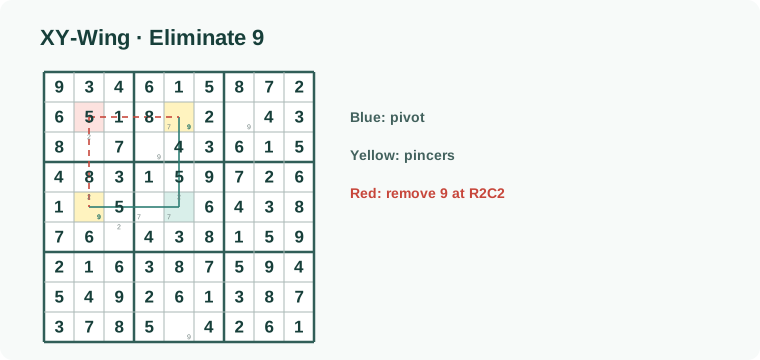
Example: eliminate 9 from R2C2
- Pivot R5C5: {2,7}
- Pincer R5C2: {2,9}
- Pincer R2C5: {7,9}
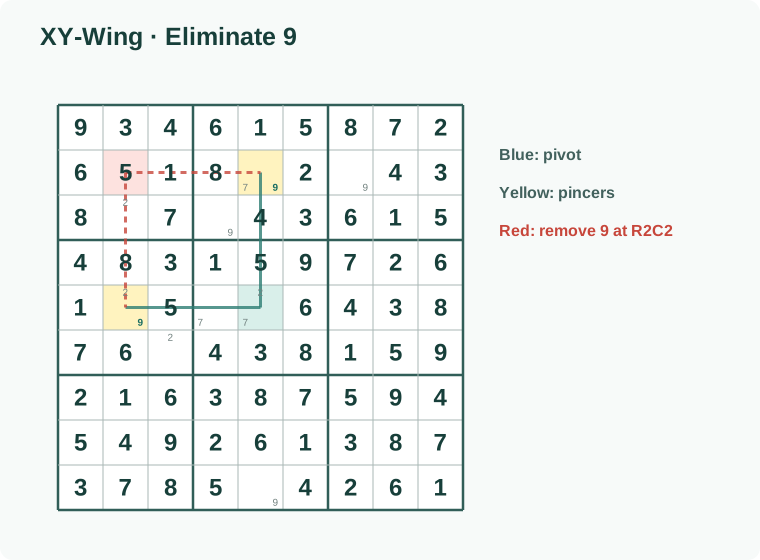
R2C2 sees R5C2 through column 2 and R2C5 through row 2, so candidate 9 can be removed from R2C2.
How to find an XY-Wing
- Find cells containing exactly two candidates.
- Choose a pivot {X,Y}.
- Find an {X,Z} pincer that sees the pivot.
- Find a {Y,Z} pincer that also sees the pivot.
- Remove Z from cells that see both pincers.
Why does XY-Wing work?
The pivot must be either X or Y. Each option forces Z into one of the pincers, so a cell that sees both pincers can never contain Z.
What does “see” mean in an XY-Wing?
Two cells see each other when they share a row, column or box. Each pincer must see the pivot, but the pincers do not have to see one another. This flexibility is why an XY-Wing may be spread across several boxes.
An elimination cell must see both pincers. It may see them through different units: in the example, R2C2 sees R2C5 through row 2 and R5C2 through column 2. Seeing only one pincer is not enough, because the other pincer may be the one forced to Z.
Choosing the pivot and pincers
The pivot is the cell that sees both of the other bivalue cells. Its two candidates pair separately with the two pincers, while the pincers share the third candidate Z.
Begin with a bivalue cell that sees several other bivalue cells. Follow each of its candidates into nearby rows, columns and boxes, looking for two cells that introduce the same third digit. Then search the shared peer area of the pincers for an actual elimination.
XY-Wing and related wing patterns
XY-Wing uses three bivalue cells and three digits. XYZ-Wing also uses three cells, but its pivot contains all three candidates. W-Wing instead connects two identical bivalue cells through a strong link. Keeping these definitions separate prevents eliminations based only on a similar visual shape.
Common mistakes
The pincers must see each other
No. Each pincer must see the pivot; the elimination cell must see both pincers.
Using four different candidates
A standard XY-Wing uses exactly three digits in the combinations XY, XZ and YZ.
Removing Z from the pattern cells
Z is removed only from other cells that see both pincers.
Summary
Find bivalue cells in the forms XY, XZ and YZ. When both pincers see the pivot, remove Z from any other cell that sees both pincers.
Frequently asked questions
What is an XY-Wing in Sudoku?
An XY-Wing uses a bivalue pivot and two bivalue pincers containing three candidates in the forms XY, XZ and YZ.
Which candidate does an XY-Wing eliminate?
It eliminates candidate Z from any cell that can see both pincers, because at least one pincer must contain Z.
Is XY-Wing the same as Y-Wing?
Yes. Y-Wing is a commonly used alternative name for the same three-cell pattern.
 My Profile