

Remote Pair Sudoku Strategy
A Remote Pair is a simple chain made from bivalue cells that all contain the same two candidates. The values alternate along the chain, allowing both candidates to be removed from a cell that sees opposite-polarity endpoints.
What is a Remote Pair?
Each chain cell contains exactly the same pair, such as {4,5}, and each consecutive pair of cells sees one another through a row, column or box. If one cell is 4, the next is 5, then 4, then 5. Reversing the first value reverses the entire chain but preserves the opposite polarity of its endpoints.
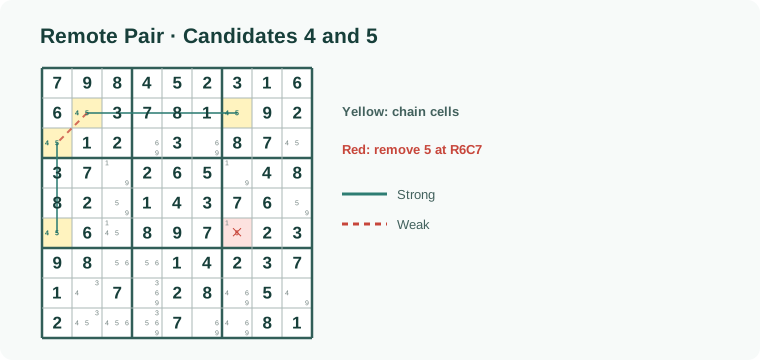
Example: remove 5 from R6C7
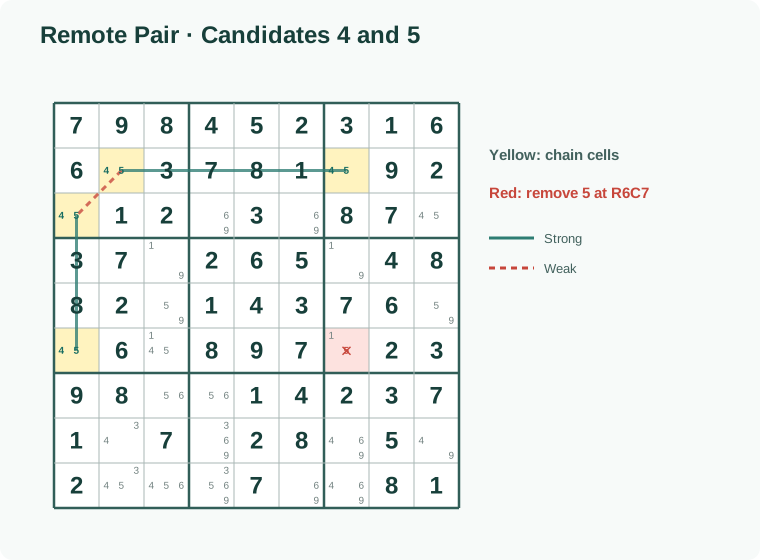
Use R2C7, R2C2, R3C1 and R6C1, all containing {4,5}. Consecutive cells see one another. R2C7 and R6C1 therefore have opposite values. R6C7 sees both endpoints, so candidate 5 can be removed. If R6C7 also contained 4, that candidate could be removed for the same reason.
How to find a Remote Pair
- Find bivalue cells with an identical candidate pair.
- Connect cells that see one another.
- Build a chain of at least four cells with alternating polarity.
- Locate an outside cell that sees two chain cells of opposite polarity.
- Remove either pair digit present in that outside cell.
Why it works
Every cell contains one of two digits, so a value chosen at one end forces every later value. Opposite-polarity cells must contain different digits under either starting assumption. A cell seeing both cannot equal either endpoint and therefore cannot contain either digit.
Remote Pair and XY-Chain
A Remote Pair is a restricted XY-Chain in which every bivalue cell contains the same two digits. XY-Chains may change pairs from cell to cell. Remote Pairs are easier to scan and are also equivalent to coloring the two candidates along the chain.
Common mistakes
Using cells with extra candidates
Every chain cell must be bivalue and contain exactly the same pair.
Eliminating from a cell that sees only one endpoint
The target must see opposite-polarity chain cells. Seeing one endpoint proves nothing.
Using endpoints with the same polarity
Same-polarity cells may hold the same value, so they do not eliminate both pair digits.
Summary
Link identical bivalue pairs, alternate their polarity, and remove the pair digits from any outside cell that sees two opposite-polarity members.
Frequently asked questions
What is a Remote Pair in Sudoku?
It is a chain of bivalue cells containing the same two candidates, with values alternating along the chain.
How long must a Remote Pair be?
A useful Remote Pair normally needs at least four cells so that two opposite-polarity members can produce an elimination.
Can the chain turn through a box?
Yes. Consecutive cells may see each other through any row, column or box.
 My Profile