

Skyscraper Sudoku Strategy
Skyscraper is a single-digit pattern built from two strong links. One endpoint from each link is aligned, while the two offset endpoints form the roofs and create an elimination.
What is a Skyscraper?
In the row-based form, one candidate occurs exactly twice in each of two rows. One endpoint from each strong link lies in the same column, while the other endpoints lie in different columns.
The aligned base cells cannot both be true, so at least one roof must be true. The candidate can be removed from every cell that sees both roofs.
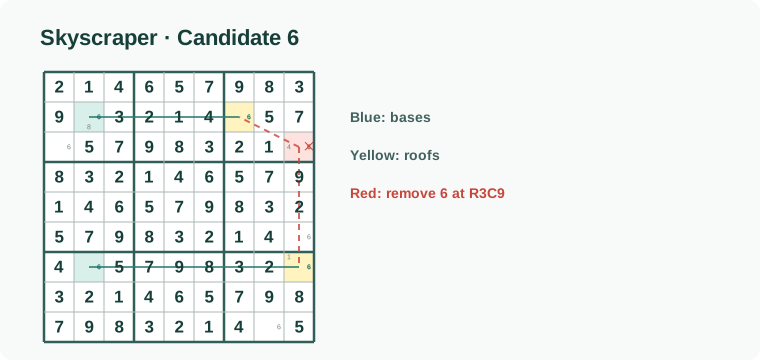
Example: a Skyscraper on candidate 6
- Row 2: R2C2 and R2C7
- Row 7: R7C2 and R7C9
R2C2 and R7C2 form the aligned bases. R2C7 and R7C9 are the roofs.
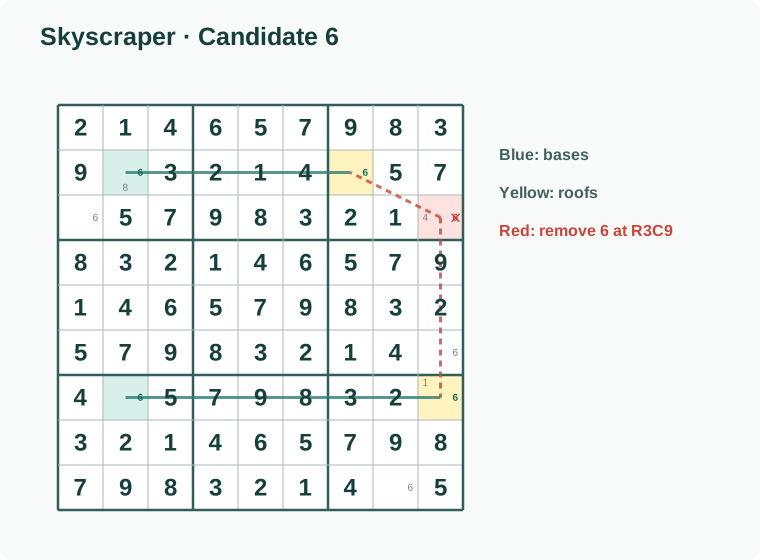
R3C9 sees R2C7 through the top-right box and R7C9 through column 9, so its candidate 6 can be removed.
How to find a Skyscraper
- Choose one candidate.
- Find rows where it occurs exactly twice.
- Compare two strong links and find a pair of endpoints in the same column.
- Treat the offset endpoints as the roofs.
- Remove the candidate from cells that see both roofs.
Why does Skyscraper work?
Each strong link has exactly one true endpoint. Because the two aligned bases share a unit, they cannot both be true. At least one roof must therefore be true.
How to confirm the strong links
A strong link exists when one candidate has exactly two possible positions in a row, column or box. One of those positions must be true. A standard Skyscraper normally uses two parallel row strong links or two parallel column strong links.
Do not identify the pattern from shape alone. If either base unit contains a third position for the candidate, its endpoints are not a strong link and the Skyscraper conclusion is invalid.
Row-based and column-based forms
A row-based Skyscraper uses two row strong links whose bases align in one column. A column-based Skyscraper uses two column strong links whose bases align in one row. The offset endpoints are the roofs in both cases.
The two roofs may affect a cell through different kinds of visibility. A target can share a row or column with one roof and a box with the other. It must, however, see both roofs before the candidate can be removed.
Practical scanning tips
For each digit, note rows or columns containing exactly two candidates. Pair strong links that have one nearly aligned endpoint, then inspect the common peer area of their offset endpoints.
Not every valid Skyscraper produces an elimination. If no unsolved cell containing the target candidate sees both roofs, the pattern cannot advance the current grid.
Common mistakes
The links are not strong
Each base row or column must contain exactly two positions for the target candidate.
The elimination sees only one roof
An elimination cell must see both roofs.
Treating Skyscraper as a rectangle
Unlike X-Wing, the roofs are offset. Skyscraper uses strong-link logic rather than rectangular cover units.
Summary
When two strong links for one candidate have aligned bases and offset roofs, at least one roof is true. Remove the candidate from cells that see both roofs.
Frequently asked questions
What is a Skyscraper in Sudoku?
A Skyscraper is a single-digit pattern made from two strong links in rows or columns, with one pair of endpoints aligned and the other pair forming the roofs.
Which candidate can a Skyscraper eliminate?
The target candidate can be removed from any cell that sees both roof cells.
Does a Skyscraper require a rectangle?
No. Unlike X-Wing, its two roof cells are offset; the logic relies on two strong links and the fact that at least one roof must be true.
 My Profile