

BUG+1 Sudoku Strategy
BUG+1 is a uniqueness technique used near the end of a standard Sudoku. Almost every unsolved cell is bivalue, while one cell contains one extra candidate. If the puzzle has a unique solution and the full BUG conditions are satisfied, that extra candidate must be placed.
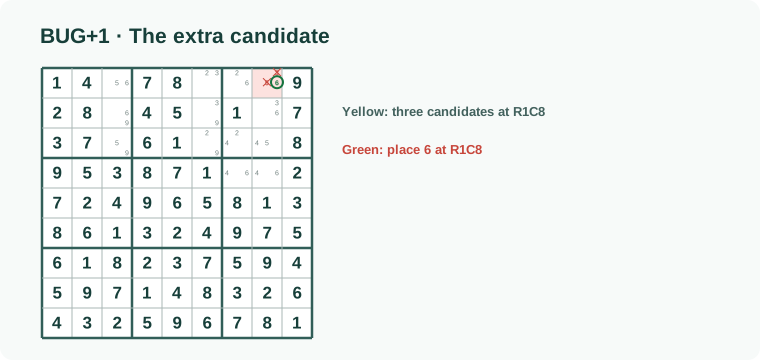
What is BUG+1?
BUG means Bivalue Universal Grave. In a pure BUG, every unsolved cell has two candidates and every candidate occurs exactly twice in each affected row, column and box, producing two interchangeable solutions. BUG+1 has exactly one cell with a third candidate that prevents this deadly pattern.
Example: place 6 in R1C8
Suppose R1C8 contains {3,5,6}, every other unsolved cell is bivalue, and candidate counts satisfy the BUG pattern except for 6 in R1C8. Removing 6 would leave a pure BUG with two solutions. Under the unique-solution assumption, R1C8 must therefore be 6.
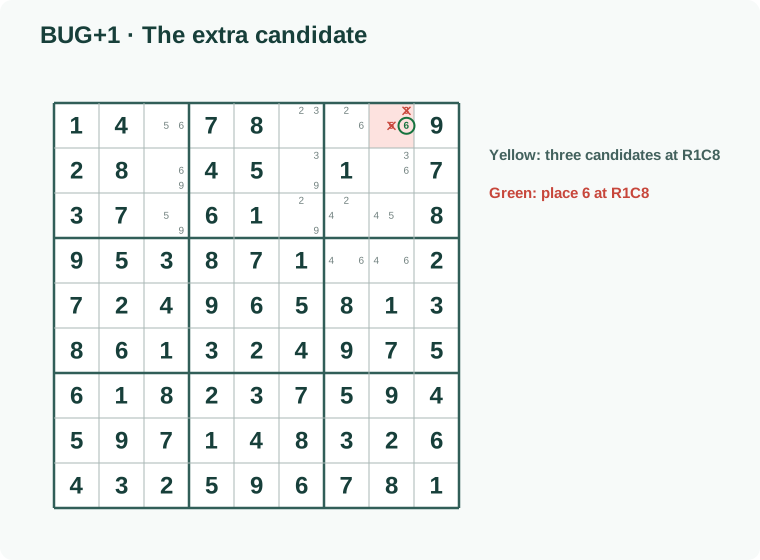
How to verify BUG+1
- Confirm that only one unsolved cell has three candidates.
- Check that every other unsolved cell has exactly two.
- Count candidate occurrences in every affected row, column and box.
- Identify the extra candidate whose removal would leave every count equal to two.
- Place that extra candidate in the three-candidate cell.
Why uniqueness matters
BUG+1 is not derived from row, column and box rules alone. It excludes the pure BUG because that state admits two solutions. Use it only when the puzzle is known to have exactly one solution; otherwise the conclusion is not guaranteed.
Common mistakes
Checking only the number of candidates per cell
Bivalue cells are not sufficient. Candidate frequencies must also meet the twice-per-unit BUG condition.
Allowing two three-candidate cells
That is not standard BUG+1 and requires different analysis.
Using BUG+1 on an unverified puzzle
The placement relies on uniqueness, so imported or hand-made puzzles should be validated first.
Practical checklist
- One and only one trivalue cell.
- All other unsolved cells bivalue.
- One extra candidate disrupts otherwise even unit counts.
- The puzzle is confirmed to have a unique solution.
Summary
If deleting one extra candidate would create a complete BUG, keep that candidate: it must be the solution of the exceptional cell.
Frequently asked questions
What does BUG stand for?
BUG stands for Bivalue Universal Grave, a deadly pattern in which the remaining candidates permit two solutions.
Does BUG+1 require a unique solution?
Yes. Its conclusion depends on excluding the two-solution BUG state.
Is one three-candidate cell enough?
No. All candidate occurrence counts in the affected rows, columns and boxes must also satisfy the BUG structure.
 My Profile