

ALS-XZ Sudoku Strategy
ALS-XZ connects two Almost Locked Sets through a Restricted Common Candidate, called X. If both sets also contain another common candidate Z, Z can be removed from any outside cell that sees every possible Z in both sets.
What is an Almost Locked Set?
An ALS is a group of N cells in one unit containing exactly N+1 candidates. Removing any one candidate value turns the remaining candidates into a locked set. ALS-XZ uses two such sets whose candidate relationships constrain one another.
What is an RCC?
A Restricted Common Candidate is a digit shared by both ALSs whose occurrences across the two sets all see one another. X cannot be placed in both sets at once. Consequently, at least one ALS must resolve without X and become locked.
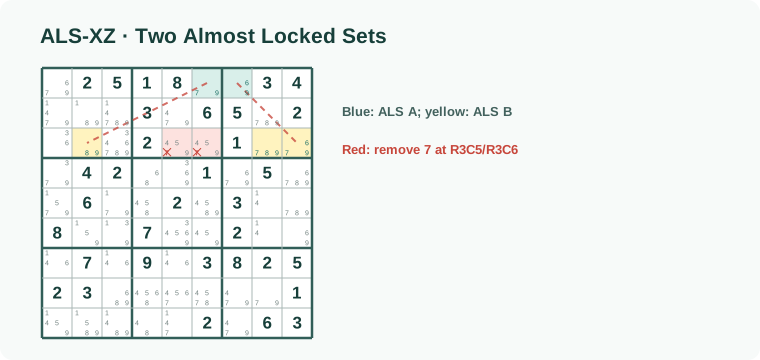
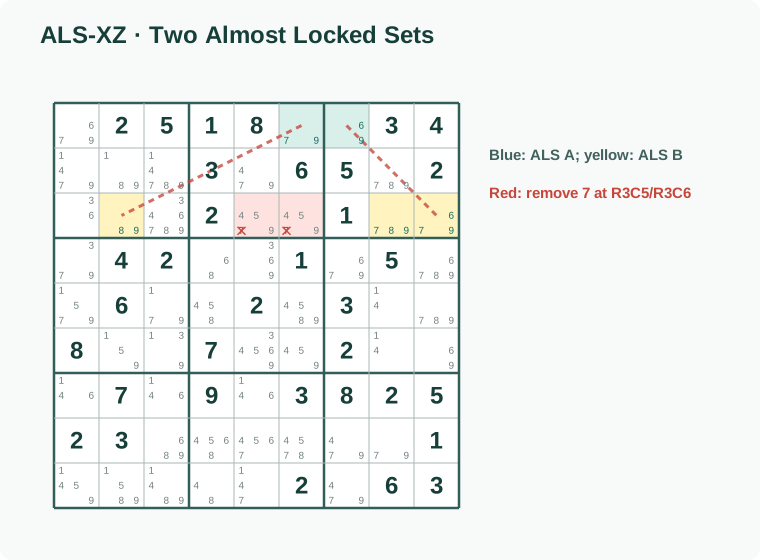
Example: remove 7 from R3C5 and R3C6
ALS A is R1C6 and R1C7 with candidates {6,7,9}. ALS B is R3C2, R3C8 and R3C9 with {6,7,8,9}. Candidate 6 is RCC X because its occurrences are restricted through box 3. Candidate 7 is shared Z. Both R3C5 and R3C6 see every possible 7 in both ALSs, so 7 can be removed from both cells.
Why ALS-XZ works
Because X cannot occur in both ALSs, at least one set must exclude X. That set then becomes locked and must contain Z. Therefore at least one Z lies somewhere in the union of the two ALSs, and a cell seeing every such location cannot itself be Z.
How to find ALS-XZ
- Mark compact ALSs: N cells with N+1 candidates.
- Choose two sets sharing candidate X.
- Verify that all X occurrences across the sets see one another.
- Find another shared candidate Z.
- Remove Z only from cells seeing every Z occurrence in both sets.
Common mistakes
Treating any shared candidate as an RCC
X must be restricted so it cannot be true in both sets.
Checking only one Z in each ALS
The target must see all possible Z locations, not a convenient pair.
Using a set with too many candidates
N cells containing more than N+1 candidates are not an ALS.
Summary
Find two ALSs linked by restricted X, identify shared Z, and eliminate Z from cells that see all Z placements in both sets.
Frequently asked questions
What does ALS-XZ mean?
It is a two-ALS technique using a Restricted Common Candidate X and another shared candidate Z.
Can the two ALSs overlap?
Some advanced definitions allow controlled overlap, but beginners should start with disjoint sets to avoid invalid RCCs.
Where is Z eliminated?
Only from an outside cell that sees every possible Z in both ALSs.
 My Profile