

Swordfish Sudoku Strategy
Swordfish extends the logic of X-Wing from two base units to three. It tracks one candidate across three rows and three columns, then removes that candidate from positions that cannot belong to the pattern.
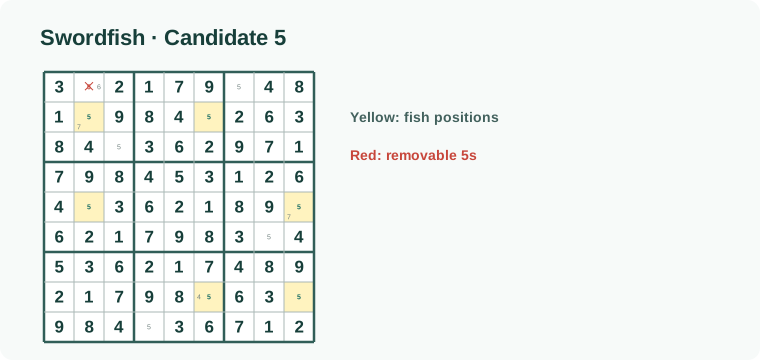
What is a Swordfish?
In a row-based Swordfish, choose three rows where every occurrence of one candidate lies within the same three columns. Each base row may contain two or three occurrences, but all of them must stay inside those three cover columns.
The three required placements in the base rows must occupy the three cover columns. The target candidate can therefore be removed from all other cells in those columns. A column-based Swordfish uses the same logic with rows and columns reversed.
Example: a row-based Swordfish on candidate 5
- Row 2: R2C2 and R2C6
- Row 5: R5C2 and R5C9
- Row 8: R8C6 and R8C9
All six candidate positions lie in columns 2, 6 and 9, so they form a Swordfish.
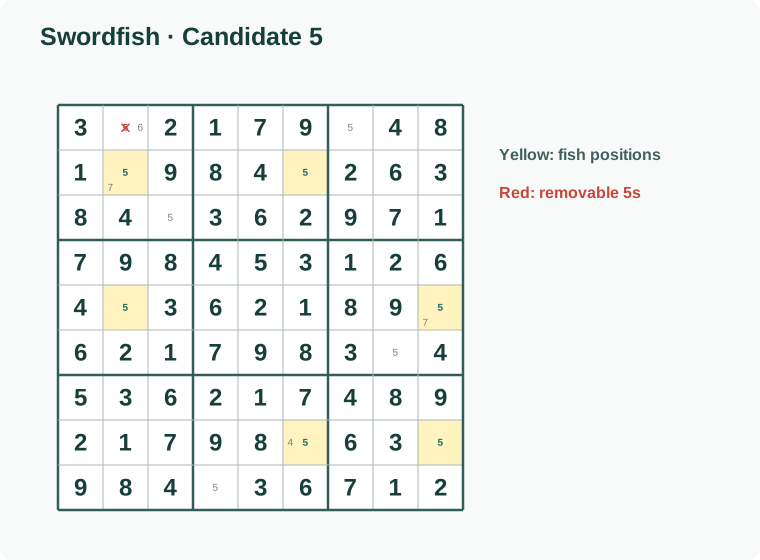
The crossed candidate 5s in the three cover columns can be eliminated because they are outside the base rows.
How to find a Swordfish
- Choose one candidate digit.
- Find rows containing that candidate only two or three times.
- Select three rows whose candidate positions use only three columns.
- Confirm that all three cover columns are represented.
- Remove the candidate from other cells in those columns.
Learning X-Wing first makes the base-unit and cover-unit logic easier to recognize.
Why does Swordfish work?
Each base row needs one copy of the target digit, and every possible position is confined to three cover columns. Those three placements must occupy the three columns, leaving no room for the same digit elsewhere in them.
Base units and cover units
The three rows selected for comparison are the base units. The three columns containing every candidate position are the cover units. In a column-based Swordfish, these roles are reversed.
The pattern does not need to look symmetrical. A base row may contain two or three positions, and the nine intersections do not all need candidates. What matters is that the union of all candidate positions uses exactly three cover units and that every cover unit participates.
Row-based and column-based Swordfish
A row-based Swordfish begins with three rows and eliminates from three columns. A column-based Swordfish begins with three columns and eliminates from three rows. The proof is identical in both directions.
When scanning, choose the direction in which the target digit has fewer candidate positions. Switching from rows to columns often reveals a compact pattern that was difficult to see from the other direction.
Practical scanning tips
Start with a digit that has several units containing only two or three candidates. Mark the cover columns used by each promising row, then compare combinations of three rows. Reject a combination as soon as it requires a fourth cover column.
A Swordfish is useful only when it produces at least one elimination outside the base units. Confirm the elimination targets before spending time proving a pattern that does not advance the puzzle.
Common mistakes
Every base row must have three candidates
No. A base row may have two or three candidate positions.
Deleting candidates inside the pattern
Keep the Swordfish candidates. Eliminate the digit only from the cover units outside the base units.
Using four cover columns
A standard Swordfish requires exactly three base units and three cover units.
Summary
When one candidate in three rows is confined to three columns, a row-based Swordfish may remove that candidate from the other cells in those columns. Reverse rows and columns for the column-based form.
Frequently asked questions
What is a Swordfish in Sudoku?
A Swordfish occurs when one candidate in three rows is restricted to the same three columns, or vice versa.
How is Swordfish different from X-Wing?
X-Wing uses two base units and two cover units; Swordfish extends the same fish logic to three base units and three cover units.
Where can a Swordfish eliminate candidates?
A row-based Swordfish removes the target candidate from other cells in its three cover columns; a column-based Swordfish removes it from the three cover rows.
 My Profile