

X-Wing Sudoku Strategy
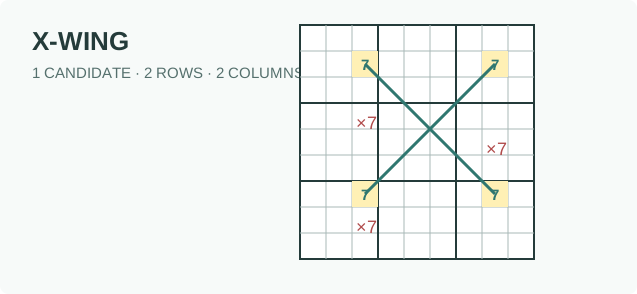
X-Wing is a basic fish strategy. It follows one candidate across two rows and two columns, using the four corners of a rectangle to create safe eliminations.
What is an X-Wing?
For a row-based X-Wing, one candidate must be restricted to the same two columns in two different rows. Whichever corner is true in the first row forces the opposite corner in the second row.
The two cover columns must therefore receive the digit at the four corners, so the candidate can be removed from every other cell in those columns. A column-based X-Wing works with rows and columns exchanged.
Example: an X-Wing on candidate 7
- In row 2, candidate 7 appears only at R2C3 and R2C8.
- In row 7, candidate 7 appears only at R7C3 and R7C8.
The four positions form an X-Wing. Candidate 7 can be removed from other cells in columns 3 and 8.
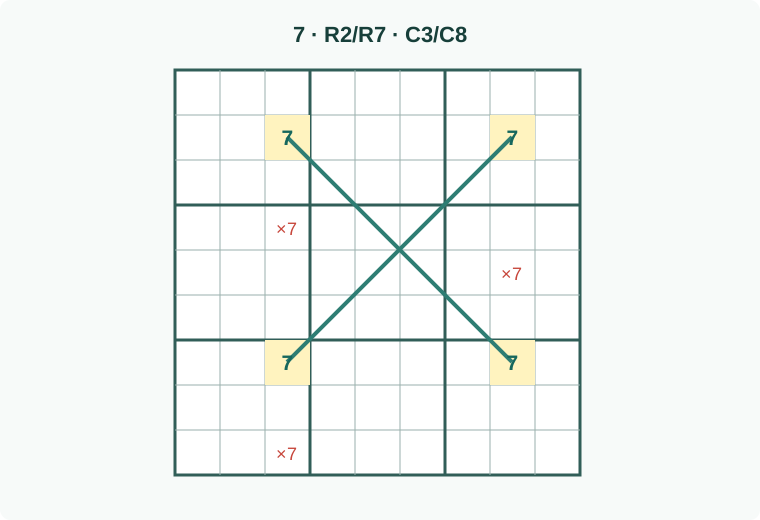
Yellow cells are the four corners; red crosses mark removable 7s in the cover columns.
How to find an X-Wing
- Choose one candidate digit.
- Find rows where it appears in exactly two cells.
- Look for two rows whose positions use the same two columns.
- Confirm the four rectangle corners.
- Remove the candidate from other cells in the two columns.
If no row-based pattern appears, repeat the search by columns. X-Wing uses row-column alignment, unlike Locked Candidates, which depends on the interaction between a box and a line.
Common mistakes
Using any four corners
In a standard row-based X-Wing, each base row must have no other position for the candidate.
Removing the four corner candidates
The corners remain possible. Remove the digit only from other cells in the cover columns.
Requiring two particular boxes
The four corners may cross more than two boxes; only row and column alignment matters.
Summary
When one candidate is restricted to the same two columns in two rows, remove it from the other cells in those columns. Reverse rows and columns for a column-based X-Wing.
Frequently asked questions
What is an X-Wing in Sudoku?
An X-Wing occurs when one candidate is restricted to the same two columns in two rows, or to the same two rows in two columns.
Which candidates can an X-Wing eliminate?
A row-based X-Wing removes the candidate from other cells in the two cover columns; a column-based X-Wing removes it from the two cover rows.
Must the four X-Wing corners lie in the same two boxes?
No. X-Wing depends on row and column alignment, not on the boxes containing its four corners.
 My Profile