

Alternating Inference Chain (AIC) in Sudoku
An Alternating Inference Chain links candidate statements through alternating strong and weak inferences. Read correctly, the chain proves that at least one endpoint is true or exposes a contradiction, producing candidate eliminations without guessing.
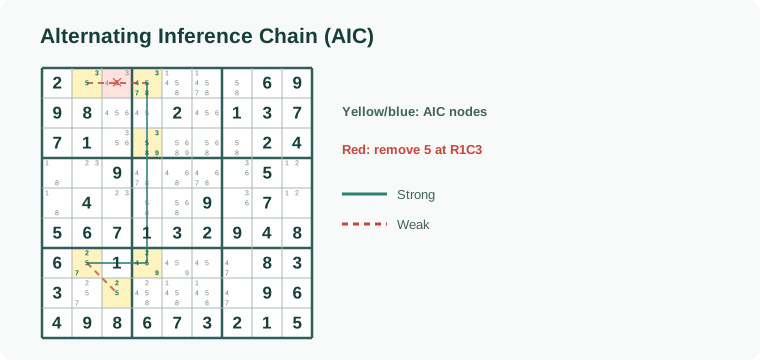
Strong and weak links
A strong link means two candidates cannot both be false: if one is false, the other is true. A weak link means they cannot both be true: if one is true, the other is false. AIC logic alternates these implications so every step follows from the previous one.
Example: an AIC on candidate 5
Consider the chain 5-R1C2-3-R1C4=3=R3C4=9=R7C4=2=R7C2-2-R8C3-5, where “=” denotes a strong link and “-” a weak link. The chain proves that candidate 5 is true at R1C2 or R8C3. R1C3 sees both endpoints, so 5 can be removed there.
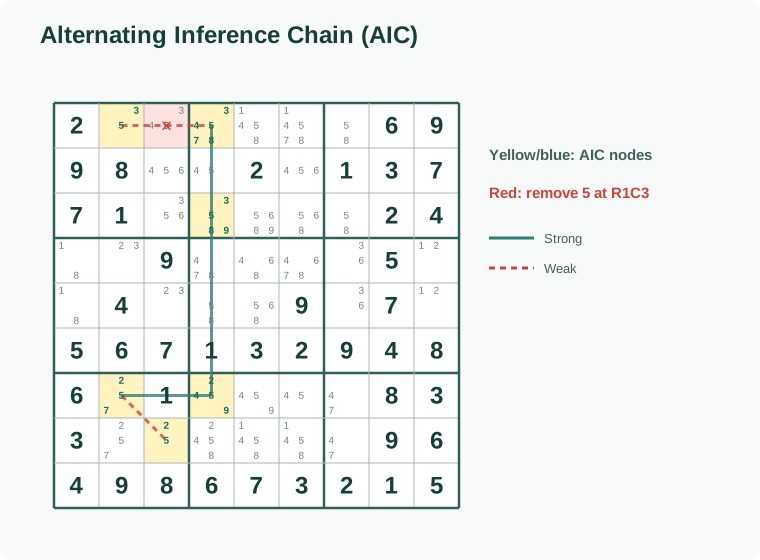
How to follow an AIC
- Choose a candidate node with a useful strong link.
- Move through a weak link to a candidate that would be false.
- Continue with a strong link forced by that false state.
- Alternate weak and strong inferences without breaking the logic.
- Use the endpoint relationship to make an elimination or placement.
Type 1 endpoint elimination
When an open AIC begins and ends with strong links on the same digit, at least one endpoint must be true. That digit can be removed from every outside cell that sees both endpoints.
AICs and nice loops
AICs and nice loops express closely related implication logic. An open AIC uses its endpoints; a discontinuous loop returns to its start with a contradiction, while a continuous loop can create eliminations along the loop. This guide focuses on the open endpoint form.
Common mistakes
Using two weak links in succession
A false candidate does not force the next candidate through a weak link. The inference sequence must remain valid.
Assuming every visible pair is strong
A strong link requires exactly two possible positions in a unit, or two candidates in a bivalue cell.
Eliminating from a cell that sees only one endpoint
Type 1 elimination requires visibility of both endpoints.
Summary
Alternate strong and weak inferences, verify every link, then use the proven endpoint relationship rather than the visual shape of the chain.
Frequently asked questions
What is an AIC in Sudoku?
An AIC is a sequence of candidate implications whose strong and weak links alternate.
Is an AIC guessing?
No. Each implication follows from candidate constraints, and the final elimination is valid under all branches represented by the chain.
What does a Type 1 AIC eliminate?
It removes the endpoint digit from cells that see both endpoints, because at least one endpoint must be true.
 My Profile