

Forcing Chain Sudoku Strategy
A Forcing Chain follows one or more possible premises until they reach a contradiction or the same unavoidable conclusion. It is an advanced, fully logical method: every valid starting option is tested through candidate implications rather than arbitrary guessing.
What is a Forcing Chain?
A single forcing chain may prove a premise false by contradiction. Multiple forcing chains start from all possible placements of a digit or all candidates in a cell. If every branch reaches the same result, that result is a verity and must be true.
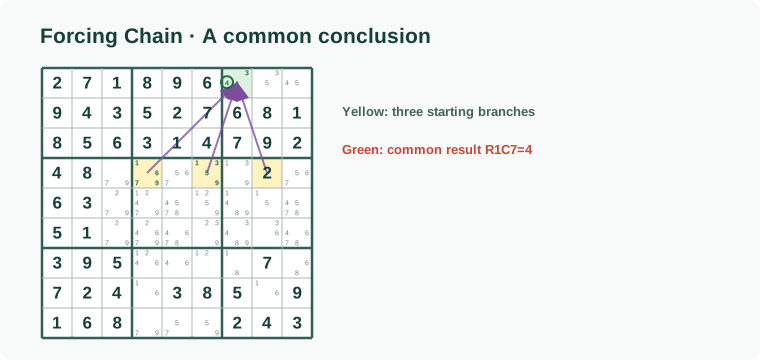
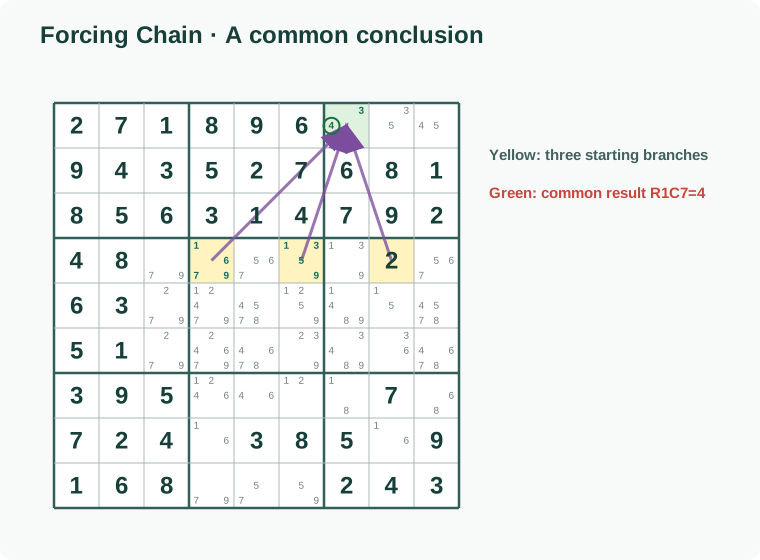
Example: every branch forces R1C7=4
Assume candidate 1 in row 4 can occupy R4C4, R4C6 or R4C8. Following the valid implications from each premise gives:
- R4C4=1 → R8C4=6 → R6C8=6 → R1C8=3 → R1C7=4
- R4C6=1 → R4C7=3 → R1C7=4
- R4C8=1 → R1C8=3 → R1C7=4
One premise must be true, and every branch ends at R1C7=4, so 4 can be placed there.
Verity and contradiction
A verity occurs when exhaustive branches share one conclusion. A contradiction occurs when a premise leads to an impossible state, such as a cell with no candidate, duplicate solved digits, or a unit with no place for a required digit. The contradictory premise is false.
How to build a forcing chain
- Choose a premise set that is complete: all candidates in a cell or all positions for a digit in a unit.
- Follow only valid strong and weak implications.
- Keep branches separate and record their conclusions.
- Stop a branch at a contradiction or a useful shared result.
- Act only when every possible premise has been covered.
Forcing Chains and AICs
AICs are structured chains with alternating inference links and often a direct endpoint rule. “Forcing Chain” is broader: it includes contradiction chains and multiple branches that converge. A forcing net branches inside a path and is more complex still.
Common mistakes
Testing only convenient branches
A shared conclusion is valid only when the starting alternatives are exhaustive.
Hiding an unsupported implication
Every arrow must follow from a genuine candidate constraint.
Confusing logic with trial and error
Record why each step is forced and use the combined proof, not a lucky branch.
Summary
Cover every possible premise, trace valid implications, and keep only conclusions that all branches prove or that follow from a contradiction.
Frequently asked questions
Is a Forcing Chain guessing?
No. It examines a complete set of logical alternatives and accepts only conclusions valid across them.
What is a forcing-chain verity?
It is a conclusion reached by every possible starting branch, so it must be true.
How is a forcing net different?
A forcing chain follows linear implications, while a forcing net can branch again inside an initial branch.
 My Profile